What the 50 Best Bars ranking really shows
Every year, when the 50 Best Bars list is unveiled, the industry pauses to look at it closely. The real question is not only who reached the top, but what this ranking chooses to highlight at a given moment. The 2026 edition, presented in Milan, offers several clues in that direction.
The most immediate fact is Bar Leone in Hong Kong, which retains the No. 1 spot for a second straight year. Founded by Italian bartender Lorenzo Antinori, the bar draws on the spirit of Roman neighborhood bars and embraces a direct, approachable idea of hospitality: drinks that feel welcoming, a relaxed atmosphere, less emphasis on technical display and more on the pleasure of being at the counter. In a ranking often filled with high-concept venues, that makes the result stand out.
The geographical picture is also worth reading as a snapshot of this year’s list rather than as a broad verdict on the global industry. Hong Kong is the most represented Asian city, with four venues. Those four bars tell very different stories: one nods to Italy, another evokes Cuba’s golden age, one is a hotel bar inside Four Seasons, and one carries the name of its Japanese founder. Together, they suggest something about the guests these spaces attract: often international, often travelling, often looking for an experience that is not tied to a single local identity.
Paris, Athens and a shifting map
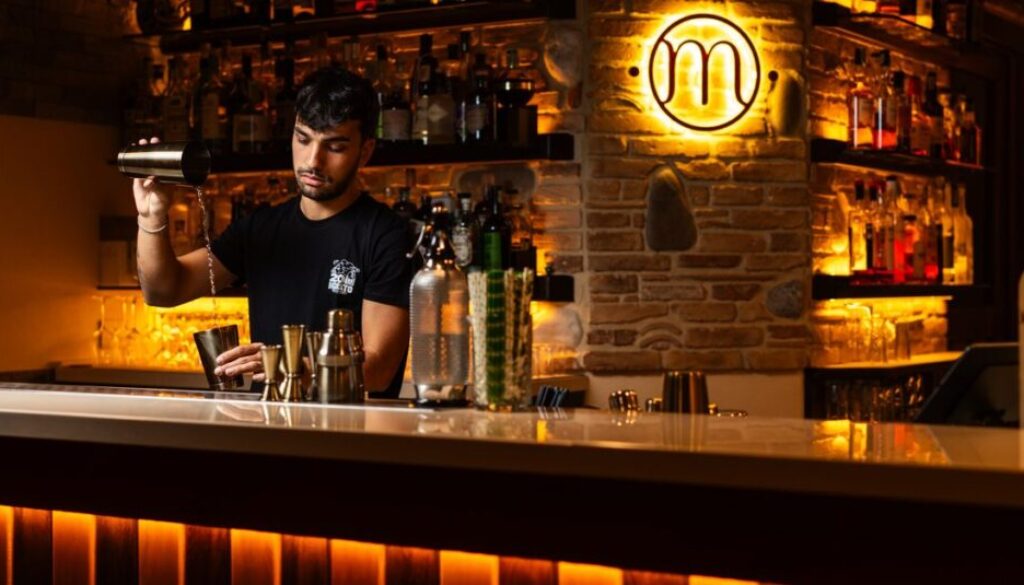
In Europe, which still accounts for a large share of the list, the most visible movement is this: for the first time, Paris overtakes London in representation, with four venues. Athens strengthens a presence that would have seemed less likely only a few years ago. Madrid returns with Angelita, while Barcelona keeps two strong positions with Paradiso and Sips. Milan, host city for the ceremony, places Moebius Milano in second place overall.
This year’s podium – Hong Kong, Milan, Cartagena – works as a compact portrait of three different ways of thinking about a bar: three continents, three contexts, three versions of hospitality. Alquímico in Cartagena reaches No. 3 and delivers one of South America’s strongest recent showings. Lady Bee in Lima and Tres Monos in Buenos Aires confirm that Latin America now has a stable, visible place near the top of the ranking.
A useful ranking, but only a partial one
It would still be a mistake to treat this list as a complete mirror of global cocktail culture. Voting is based on recent experiences from industry professionals, which makes the result sensitive to travel patterns, international circulation and the visibility certain bars are able to build over time. A venue visited less often by foreign observers may collect fewer votes even if the quality of what happens behind the counter remains exceptional.
There is also the question of what the ranking actually rewards. A bar that builds its identity around local culture, regional ingredients or the stories of its community often starts with less international visibility than a venue that is well connected to the global industry network. Tlecān in Mexico City, dedicated to pre-Hispanic culture and to telling the country’s history through drinks, shows that both approaches can coexist. But it is a difficult balance, and the ranking does not always reward it in equal measure.
Sustainability also appears in a more restrained way this year. Rather than reading that as a retreat, it may be more accurate to see it as a sign of normalization: some practices are becoming part of the everyday running of good bars and no longer need to be presented as exceptional.
Another signal comes from Japan. Virtu, the bar at Four Seasons Hotel Tokyo at Otemachi, sits within a highly recognizable bar culture shaped by omotenashi – a style of hospitality that anticipates a guest’s needs – and by ingredients such as yuzu, shiso and shochu. This is not a decorative layer: it is a precise identity, developed over time and still capable of gaining international recognition.
With all its limitations, the list remains useful precisely because it shows where attention, investment and conversation are concentrating in the bar world. It does not tell the whole story, and it does not try to. But it does offer a fairly clear reading of which ideas of excellence feel most widely shared, לפחות among those who vote.