Do energy drink trends really travel from the UK to Italy?
Twenty years ago, if someone had suggested that a simple can would become a cultural symbol, few would have believed it. Yet energy drinks have achieved something few food products can claim: transforming themselves from functional beverages into genuine cultural phenomena.
Their success today depends not only on what’s inside the can — typically caffeine, taurine, B vitamins, and in many cases other functional ingredients like glucuronolactone or plant extracts — but above all on brands’ ability to build a recognisable identity, grow communities of consumers, and exploit new forms of digital communication. To understand where the Italian market might be heading, it’s worth looking at what’s happening in the English-speaking world, particularly in the United Kingdom, one of Europe’s most mature and innovative markets.
This doesn’t mean that every trend born in the British market automatically makes its way to Italy. But looking at recent years, it’s clear that many product and marketing innovations found fertile ground in the English-speaking world before eventually arriving in Italy too.
The sector continues to grow globally and is now one of the most dynamic segments in the beverage industry. According to major market analyses, the value of the category is set to increase further in the coming years, driven by innovation and expanding demand. In Europe, the market is already worth tens of billions of euros, with forecasts pointing to further growth. Italy is following the same trend, though at a different pace and with its own characteristics compared to the UK, where the market is well established and highly competitive.
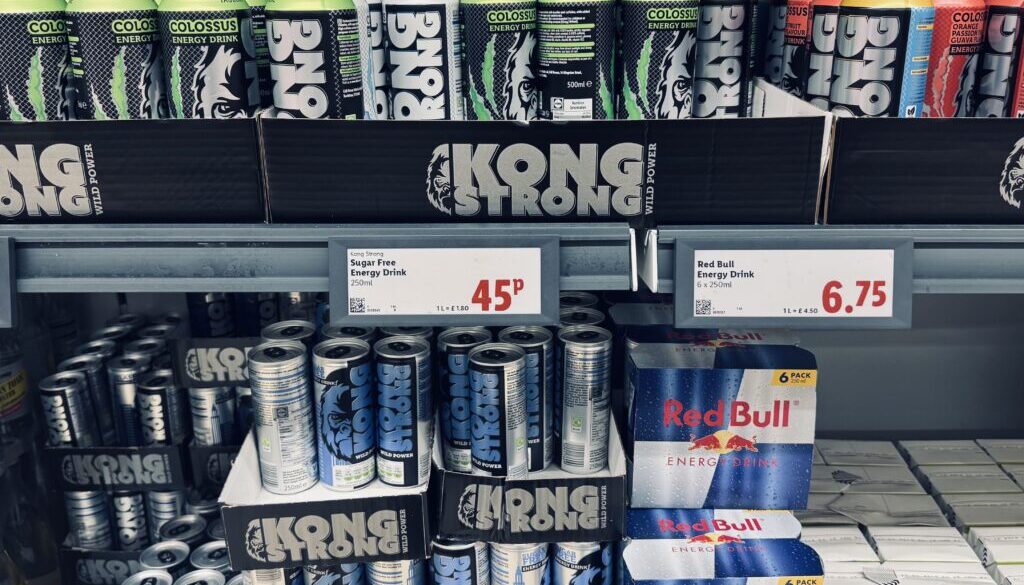
One of the most interesting aspects is that the UK is often used as a pilot market. Companies launch new flavours, innovative formulas, original packaging and commercial strategies there first — and if they succeed, roll them out across other European countries. Watching the British market, in this sense, often means spotting in advance the trends that may shape the Italian market in the years ahead.
Marketing is the real engine of growth
Probably no other category in the beverage sector has invested so heavily in image-building. In the 2000s, the success of energy drinks was tied mainly to extreme sports, Formula 1, motocross and high-impact media events. Brands were selling adrenaline before they were selling a drink.
In recent years the landscape has changed dramatically. Today the main competitive arena is social media. TikTok, Instagram, YouTube and Twitch have replaced much of traditional advertising, allowing brands to speak directly with millions of consumers, especially young people.
The role of influencers has become central. They’re no longer simply hired to promote a product — they actively participate in shaping the brand’s identity. In some cases, the product is built around the creator’s popularity from the very beginning.
The most well-known example is Prime, the brand created by YouTubers Logan Paul and KSI. Before it achieved international distribution, it had already become a global phenomenon thanks to its founders’ online fame. Millions of followers generated enormous demand, showing how commercial success today can depend as much on building a community as on the quality of the product itself.
This shift is probably the most important difference from the past. Consumers no longer simply buy an energy drink — they choose a brand to identify with. The can becomes a symbol of a lifestyle, a community and a particular way of communicating.
The product itself has evolved
From a nutritional standpoint, energy drinks are typically formulated with caffeine, taurine, B vitamins, and — depending on the product — other functional ingredients such as glucuronolactone, guarana, ginseng or amino acids. In recent years, many companies have also developed sugar-free versions and products with naturally sourced ingredients, responding to growing consumer interest in health and nutritional quality.
The consumer profile has shifted too. Where the focus was once almost exclusively on caffeine’s stimulating effect, today there is growing demand for products with less sugar, fewer calories and formulations perceived as more balanced. Sugar-free versions are constantly increasing and represent one of the fastest-growing segments of the market.
The major companies are continuously expanding their offering, with dedicated lines for athletes, students, professionals and, more broadly, anyone looking to maintain high levels of energy and concentration throughout the day. Packaging is also playing a strategic role: carefully designed aesthetics, limited editions and influencer collaborations all contribute to strengthening brand value.
What the Italian market can learn
The comparison between Italy and the UK reveals two markets at different stages of the same evolutionary journey. In the British market, many trends are already well established; in Italy, they are beginning to take hold at an increasing pace. The spread of social media is shortening the time it takes for a new product to become known in our country too.
For Italian companies, this represents both an opportunity and a challenge. Developing a good drink will no longer be enough: it will be necessary to build a brand capable of communicating effectively with consumers, making use of new digital tools and responding to the expectations of younger generations.
This is precisely the key lesson from the English-speaking market. Innovation is not just about the recipe — it’s about the entire ecosystem surrounding the product. Those who manage to build a community of consumers, tell a credible story and use new communication channels effectively will likely hold a significant competitive advantage in the years ahead.
Energy drinks are, then, far more than a simple product category. They are one of the most compelling examples of how innovation, marketing and changing consumer habits can turn a food product into a global phenomenon. Watching more mature markets — like the UK — often means catching early a glimpse of the trends that could shape the Italian market in the years to come.
References
European Food Safety Authority (EFSA). Scientific Opinion on the Safety of Caffeine.
European Parliament Research Service (EPRS). Energy drinks and children: public health considerations.
Grand View Research. Europe Energy Drinks Market Size & Trends Analysis Report.
Grand View Research. UK Energy Drinks Market Size & Trends Analysis Report.
British Soft Drinks Association (BSDA).
Food Standards Agency (UK).
Italian Ministry of Health (Ministero della Salute).
Statista – Energy Drinks Market Statistics.