When to Decant a Wine and When It Is Better Not To
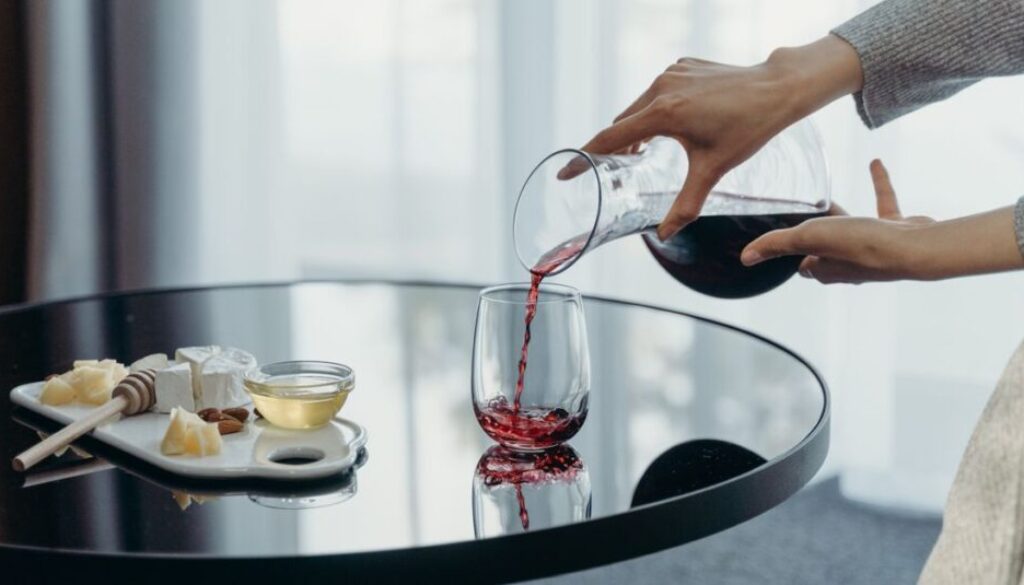
Opening a bottle carefully, pouring its contents slowly into a glass decanter and watching the liquid catch the light as it flows: it is a moment many enthusiasts associate with the very idea of serving wine well. But the decanter is neither a decorative object nor a universal tool. Using it well means understanding, first of all, why you are using it — and then, equally important, recognising when it is better not to use it at all.
Behind the word decanting, two distinct operations are often conflated. The first is physical: separating wine from the solid deposits that form naturally in bottles after years of ageing — tartrate crystals, polymerised pigment residues — which, if they end up in the glass, alter both structure and mouthfeel. The second is chemical: exposing wine to oxygen to encourage the opening of aromas, soften austere tannins, and dispel any reductive notes. Two objectives that sometimes coincide in a single gesture, but that often call for completely opposite approaches: slow and careful in the first case, more vigorous in the second. Conflating them leads to real, hard-to-correct mistakes.
When the decanter genuinely helps
The most natural candidates for decanting are young, structured reds: wines with tightly wound tannins and a density of material that struggles to express itself in the first minutes after opening. A Barolo five or six years old, a young Amarone, a well-extracted Cabernet Sauvignon, or a southern Italian Syrah that seems closed on the nose — in these cases, oxygen genuinely does its work. It does not soften tannins by magic, but it accelerates a polymerisation process that would otherwise take far longer in the bottle: smaller tannin molecules combine to form larger structures, and the sensation in the mouth shifts from grippy and drying to something more integrated and rounded.
How long to leave the wine in the decanter depends on many variables: the grape variety, the vintage, the extraction method, storage conditions, even the type of closure used. As a rough guideline, many young structured reds open up somewhere between thirty minutes and about an hour and a half — but that window is only a starting point. Tasting every fifteen to thirty minutes is the most reliable way to tell whether the wine is gaining complexity or has already reached its peak.
Another situation where the decanter earns its place is when a wine shows reductive notes: that closed, slightly sulphurous smell — like a struck match or a sealed room — that sometimes emerges right after opening. It is a phenomenon linked to maturation in low-oxygen environments, and in most cases it eases with exposure to air. Times can vary: thirty or forty minutes is often enough, but it is worth checking in the glass first, since some wines respond more quickly and others take a little longer.
Some structured white wines can also benefit from a brief spell in the decanter — certain oak-aged Chardonnays, orange wines with extended skin contact, or aged white Burgundies with years in bottle. In these cases, however, timing should stay short. The aromatic compounds in whites are inherently more volatile and dissipate quickly: fifteen to twenty minutes is a reasonable reference point, but tasting frequently is essential, because some whites lose their most delicate aromas faster than expected. For rosés, a little movement when pouring into the glass is generally sufficient.
- Young, structured reds — roughly 30 to 90 minutes as a guideline, depending on tannin density, vintage and how closed the wine is on the nose. Taste every 15–30 minutes to track the wine’s progress.
- Reds with reductive notes — 30 to 45 minutes is often enough to ease unpleasant odours, but times vary; try the wine in the glass first and reassess at short intervals.
- Aged reds with sediment — slow, careful decanting to separate deposits, then serve promptly: these wines are fragile and oxidise quickly.
- Structured or closed whites — 15 to 20 minutes as a reference, only if genuinely needed; taste frequently because volatile aromatics can fade faster than expected.
- Very old, delicate reds — avoid prolonged decanting. Pour gently and allow the wine to open slowly in the glass.
- Sparkling and pétillant wines — generally avoid decanting: effervescence is lost within minutes. Rare, intentional exceptions exist — for example with certain historic sparklings where loss of bubbles is a deliberate stylistic choice — but these are specialist cases.
When the decanter can cause harm
The most nuanced situation — and the most underestimated — involves wines that are already well evolved. A great red with fifteen or twenty years of bottle age has built a delicate equilibrium between aromatic compounds, structure and acidity over a long period. That equilibrium is also shaped by the bottle’s own history: how and where it was stored, in what conditions, under what kind of closure. Oxygen, which acts as an ally for young wines, can shatter that balance for mature ones in a matter of minutes. Tertiary aromas — leather, tobacco, forest floor, dried spice — that make an aged wine compelling are highly volatile. In a wide-bowled decanter, they can vanish before the wine even reaches the glass.
The more cautious approach in these cases is to open the bottle, pour a small first taste, and allow the wine to open gradually in the glass rather than forcing the process. If removing sediment is necessary, the decanting itself should be performed very slowly — keeping the bottle nearly horizontal, stopping as soon as the liquid turns cloudy — and the wine should be consumed without delay, not left sitting in the vessel.
It is worth restating the distinction between decanting and aerating, because conflating them leads to errors in opposite directions. Decanting in the strict sense means transferring wine while separating it from deposits: the goal is physical, and the process requires patience. Aerating means exposing wine to air to open its aromas, and for a young wine without sediment this can happen vigorously, with a lively pour that deliberately incorporates oxygen. Handling an old, sediment-heavy wine as if it were a young red that needs energetic aeration, or being unnecessarily gentle with a structured young wine that would benefit from decisive contact with air: these are mirror-image mistakes, both avoidable with a little awareness.
The most reliable signal comes from the glass
Working from fixed time rules — two hours for this one, thirty minutes for that one — is a starting point, not a doctrine. The real indicator is the wine in front of you at that specific moment: how does it smell right after opening? Are the tannins still tightly coiled or beginning to relax? Is there a closed, unconvincing quality on the nose? Tasting after the first few minutes in the decanter, and again a little later, is the most honest way to follow the wine as it opens. When the aromas begin to flatten rather than unfurl — when fruit gives way to a uniform, muted note — the signal is unambiguous: it is time to pour, not to wait.
There are also alternatives to the decanter worth knowing. A wide-bowled glass with a little swirling allows for more controlled, gradual oxygenation — useful when you are uncertain about how evolved a wine is, or when you want to proceed carefully without risking the loss of something precious too quickly. The double decant — pouring from bottle to carafe and then back again — is a more vigorous technique suited only to very closed young reds and should be used with restraint: it can accelerate opening noticeably, but it carries a real risk of over-oxidation if applied to a wine that does not need it. And in some cases — especially with bottles whose provenance or storage history is unclear — the wisest choice is simply to open the bottle, wait a few minutes, and taste: the nose and palate will tell you with precision whether that wine still has something to gain from air, or whether it has already arrived where it needs to be.
What changes, compared to reaching for the decanter as an automatic step, is awareness: knowing that you are not decanting out of habit or for the aesthetics of the moment, but because that specific wine, at that specific moment, with its particular history behind it, has something concrete to gain from contact with air — or something concrete to lose.