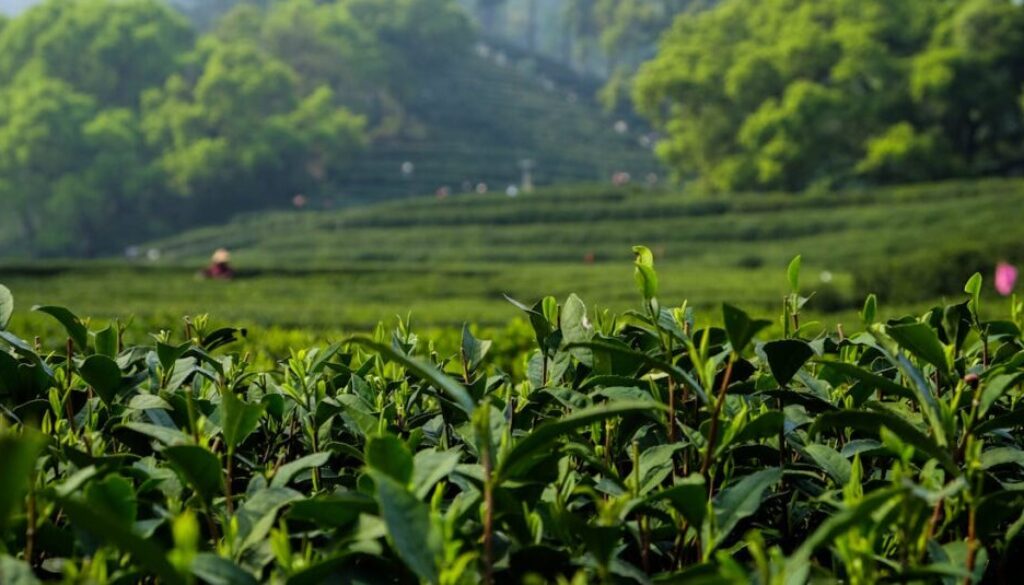
Tea under pressure: prices, matcha and the new sustainability map
The tea world is going through a period of change that touches markets, territories and production models. On one side, interest in matcha continues to rise, bringing it well beyond the niche audience that once defined it. On the other, new questions are emerging around origin, sustainability and the ability of supply chains to withstand growing economic and environmental pressures. Tea, in other words, is no longer just an ancient and reassuring drink: it is becoming one of the most revealing categories through which to observe the relationship between taste, consumption and agricultural transformation.
Matcha is reshaping Japanese tea, but the picture is more complex
In Japan, the opening of the 2026 season showed clearly how much matcha is influencing the sector’s balance. In Kagoshima, during the first trading session for the new harvest, the average price of tea offered on the market rose to 6,573 yen per kilogram, roughly 60% higher than at the start of the previous season. In Uji, in Kyoto Prefecture, a hand-picked and hand-processed gyokuro reached a peak of 500,000 yen per kilogram.
These are strong signals, tied to international demand for Japan’s most distinctive teas and especially for everything surrounding matcha. Europe and the United States remain crucial markets in this expansion, driven not only by traditional consumption but also by matcha’s growing presence in contemporary cafés, pastry culture and a broader wellness aesthetic that has made it far more visible in recent years.
The picture, however, is not uniform. In Shizuoka, one of Japan’s historic tea-growing regions, the market is showing more mixed signals, and the prefecture is looking for new ways to strengthen its identity abroad. One of them is JAPAN TEA SHIZUOKA, an umbrella brand created to support the region’s tea on international markets. Alongside it, electronic auction systems are being introduced to make trading more accessible to buyers beyond Japan.
There is also a less visible vulnerability behind the consumer-facing success of matcha: some stages of harvesting and processing still rely on fuels and materials tied to the wider energy economy. For Japanese producers, instability in global energy markets is therefore something to watch closely, especially during the busiest periods of the season. Matcha’s momentum is real, but it does not exist outside the pressures affecting contemporary agriculture.
New geographies of tea
The rise of matcha is not only influencing Japan. It is also encouraging experimentation beyond Asia’s traditional tea centres. In Hawaii, where agriculture has long been associated with crops such as coffee, pineapple and macadamia nuts, a small but increasingly visible community of growers is working to build a local tea supply chain.
Tea Hawaii & Co., founded by Eva Lee on Hawaii Island and focused on premium teas grown in forested environments, is one of the most interesting examples. The point is not simply to produce tea in a place that remains unusual in the public imagination. It is also about keeping more value within the territory itself, developing local skills, processing capacity and collaboration.
A similar dynamic can be seen in Washington State and Oregon, where some growers are experimenting with propagated plants from selected cultivars in order to shorten the path toward commercially sustainable production. It is still an early and difficult journey, shaped by limited resources, uneven agricultural research and a culture of supply-chain cooperation that is still developing. That is precisely what makes it interesting: it tells the story of a tea sector searching for new places, new models and a presence closer to its consumers.
In Hawaii, the conversation also intersects with a wider issue of agricultural autonomy. The islands still import around 85% of the food they consume, despite climate conditions that allow cultivation throughout the year. In this context, efforts to reduce dependence on external inputs and make better use of local resources take on a significance that extends beyond tea itself. The beverage becomes part of a broader reflection on territory, self-reliance and quality.
Sustainability, labour and new ways of imagining tea
Another decisive front is regenerative agriculture. Regen Tea, an initiative promoted by Tea Rebellion to accelerate the adoption of regenerative practices across the tea supply chain, has entered a pilot phase that, according to the project, involves around 15 farms in eight countries. Its stated goal is to reach at least 10,000 hectares managed under verified regenerative practices by 2035.
Beyond the quantitative targets, the editorial point is clear: sustainability in tea can no longer be treated as a decorative addition to the story of the product. It concerns biodiversity, soil health, lower dependence on costly inputs and the ability of small growers to remain part of the market without being overwhelmed by climatic and financial instability. Smallholders represent a decisive share of the global tea chain and, according to the most widely cited estimates, contribute roughly 60% of world tea production.
The environmental dimension is inseparable from the social one. In India, the world’s second-largest tea producer, the shift from the Plantation Labour Act of 1951 to the new labour codes is changing the regulatory framework for plantations. The real impact will depend on how those rules are applied across different states, but the issue matters: the conditions of tea workers remain one of the great unresolved questions of a sector that is too often narrated only through the elegance of the finished cup.
Something is shifting on the consumption side as well. Some brands are exploring products that pair flavour with a functional promise, as shown by the launch from Pure Leaf, a brand within the Pepsi Lipton Tea Partnership, of sparkling iced teas made with black tea and added l-theanine. It is a secondary signal, but not an irrelevant one: while cultivation and supply chains are being rethought upstream, tea is also searching for new languages with which to enter everyday life.
From Japanese auctions to experimental fields in Hawaii, from regenerative programmes to new formats of consumption, tea is undergoing a transformation broader than the matcha craze alone might suggest. It is not simply a beverage gaining momentum: it is a category redefining its relationship with origin, desire and responsibility.