Why Do We Swirl Wine in the Glass
It is a gesture that divides more than it might seem. You see it performed with studied seriousness in tasting rooms, with casual ease at wine bar counters, and occasionally with a faintly theatrical enthusiasm in restaurants. Swirling wine in the glass has become a kind of recognition signal among those who take wine seriously — but the real reasons behind that small circular motion are more concrete, and more interesting, than its ritual air suggests.
Start with the chemistry, without overcomplicating it. When wine sits still in a glass, its aromatic compounds — the molecules responsible for everything the nose perceives — have a limited surface area from which to evaporate. Swirling the glass causes the wine to climb up the sides, increasing its contact with the air and making it easier for certain aromatic components to move into the headspace above the wine. Not all compounds respond in the same way: some are highly volatile and express themselves quickly, while others need more time, temperature or movement to become perceptible.
Sensory and analytical research on glass agitation — including work published in OENO One on the volatilisation of specific compounds, such as those linked to certain reductive odours — confirms that swirling can have measurable effects on the composition of the aromatic space above the wine. The extent of that effect, however, varies according to the compound, the wine matrix and the serving conditions. This is not the same kind of oxygenation that happens when you uncork a bottle and let it breathe, nor is it the same as decanting, which introduces air in a different and often more significant way. In the glass, it is better understood as a brief surface aeration: a few seconds that can make the wine more readable on the nose without deeply transforming it.
This matters especially for structured or evolved red wines, particularly when they seem closed, compressed or not very expressive at first. In these cases, swirling is not affectation — it is a tool. In mature wines, some evolved notes may initially feel restrained or blurred within the wine matrix, and a gentle swirl can help make them more legible. It is not only a question of volatility: temperature, oxygen, the wine’s structure, the bottle’s stage of evolution and the shape of the glass all play a role.
How many rotations are useful depends on the wine. As a general rule, one or two slow turns are enough to understand whether the gesture is helping. Going further does not necessarily improve the result: it may disperse some more delicate aromas, accelerate warming in the glass and make the tasting less precise. In very fragile or already evolved wines, excessive exposure to air can also become counterproductive. The simplest way to judge is to smell the wine twice: first while the glass is still, then after one or two controlled swirls. If the aromatic profile becomes clearer, the swirl has done its job; if the wine seems less precise or more alcoholic on the nose, it was probably open enough already.
The shape of the glass, it should be said, already does a significant share of the work. For structured reds, a wide bowl that allows easy movement, with a rim slightly narrowed to concentrate aromas toward the nose, helps the wine express itself. This is the kind of glass that best supports great Bordeaux, Barolo, Brunello and long-ageing reds: wines that need space to open up, and that can lose part of their complexity in a glass that is either too narrow or too wide.
The tears on the glass: what they actually tell you
Swirling the glass also serves a second purpose, often overlooked or misread: observing what are variously called tears, legs or arches — the droplets that form on the inside of the glass after the wine has been swirled and then slowly slide back down. What you are looking at is a visual clue about the wine’s composition, but not a definitive proof of its quality.
The phenomenon is strongly linked to alcohol and to the difference in surface tension between water and alcohol, often described through the Gibbs–Marangoni effect. In general, wines with higher alcohol content tend to make the phenomenon more visible, but the shape, speed and density of the tears do not depend on alcohol alone: glycerol, residual sugar, overall viscosity, wine temperature, glass cleanliness, air humidity and environmental conditions all matter. Research dedicated to the dynamics of wine tears has shown how much more complex the phenomenon is than the quick reading often made at the table might suggest.
That said, this visual reading is indicative, not diagnostic. It is one of several signals a taster collects — not a verdict on the wine’s quality, structure or value. Using it as a standalone criterion would be like judging a person by how they walk: sometimes revealing, always partial.
Sparkling wines: perlage and aromas do not tell the same story
Sparkling wines deserve a more precise distinction. Swirling a glass of Champagne, Franciacorta, Prosecco, Cava or any wine containing carbon dioxide inevitably accelerates the loss of CO₂. The perlage loses part of its continuity, the foam fades more quickly and the tactile sensation of the bubbles can become less precise. If the aim is to assess the finesse, persistence and quality of the bubbles at their best, then swirling should be avoided or kept to a minimum.
This does not mean, however, that a sparkling wine should never be swirled. If the aim is olfactory evaluation, a light and controlled swirl can also help with sparkling wines, especially more complex traditional-method wines, where fruity and floral notes are joined by hints of yeast, bread crust, dried fruit, spices, ripe citrus and subtle evolved nuances. It is a technical choice: you gain clarity on the nose, while accepting that you sacrifice something in terms of perlage.
The real question, then, is not whether sparkling wine “should” or “should not” be swirled in absolute terms. The correct question is: what am I evaluating? If you are observing the grain of the bubbles, their persistence and the way they rise through the glass, the wine should be left as still as possible. If, on the other hand, you are trying to read the aromatic profile more clearly, a measured swirl can make sense, provided you accept the compromise on CO₂. Here too, awareness matters more than the rule.
For sparkling wines, the flute preserves the vertical perception of the perlage well, but for complex Champagne and traditional-method sparkling wines many producers and tasters now prefer a tulip-shaped glass, which can gather the bubbles without sacrificing too much aromatic expression. The glass, as always, is not an aesthetic detail: it shapes what you are actually able to perceive.
Whites, rosés and young wines: measure rather than habit
For fresh white wines and rosés, the answer is more nuanced. A gentle swirl can unlock certain aromatic nuances, but it needs to be calibrated. These wines are often served at lower temperatures than reds, and excessive agitation speeds up warming in the glass, working against the freshness that defines them. A Sauvignon Blanc, a Vermentino, a young Riesling or a fragrant rosé may benefit from a light swirl, but they do not need to be treated like a great evolved red.
Often, with a young and aromatic white, it is enough to smell the wine first while the glass is still and then after one brief swirl. If citrus, flowers, herbs, white fruit or varietal notes become clearer, the gesture has helped. If the wine loses tension, seems warmer or feels less precise, it is better to stop. Here too, the right glass — wide enough to let aromas develop, but not so large that it disperses fragrance — often does more work than the swirl itself.
How to actually do it
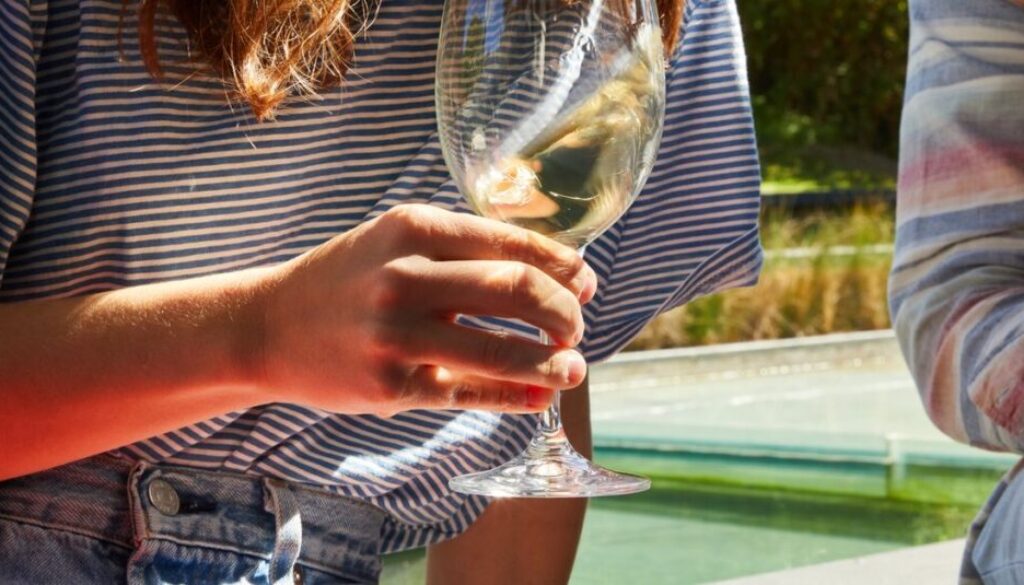
The correct technique is less complicated than it looks and requires no broad or theatrical movement. In professional tasting, the glass is held by the stem and moved with a controlled circular motion of the wrist, small but continuous, enough to make the wine rise along the sides without creating an excessive vortex. The gesture should be precise, not showy: if the wine reaches the rim or risks spilling, that is not mastery, just haste.
Swirling with the base of the glass resting on the table can be useful for those with little experience, or when the glass is very full and the risk of spilling is real. It is a practical solution, not the professional reference gesture. It can help you become familiar with the movement, but in a technical tasting real control is exercised by holding the glass in the hand, always by the stem, without warming the bowl with the palm.
Hold the glass by the stem, not the bowl. The reason is practical: the hand transfers heat, and for a wine served at the correct temperature — especially a white or a sparkling wine — even gradual warming can affect aromatic perception, particularly over a longer tasting. For a brief sip the effect is more limited, but keeping to the stem remains the more sensible habit.
How much wine you pour matters more than it might seem. With less than half the glass filled, the swirl is manageable and the movement is easy to control. With too much wine inside, the gesture becomes awkward and the risk of spilling is real. Pouring less is not a concession — it also leaves room for the aromas to gather above the surface of the wine, amplifying what the nose picks up on first approach.
Ultimately, this gesture is not ceremonial. It is practical: it helps you understand what is in the glass, trace how a wine evolves over the minutes you spend with it, tell the difference between a wine still holding back and one that is ready, and choose consciously whether to prioritise aroma, perlage, freshness or tasting precision. Knowing what you gain and what you sacrifice is the difference between a reflex and an act of attention. Which is exactly the right way to approach a wine worth paying attention to.