2026 harvest: when timing matters most
The 2026 Italian harvest is telling a clear story in a number of places: growers are having to watch the calendar more closely than usual. In Franciacorta, harvesting began in the first days of August. In Trentino, Ferrari Trento, a leading producer of Trentodoc sparkling wine, started on August 10 with the first Chardonnay grapes for its base wines, describing it as one of the earliest harvests in its history. In the Euganean Hills, picking began around the same date, roughly a week earlier than in 2025. In Maremma, meanwhile, the start of harvest looks markedly earlier than historical averages.
But the real issue is not only when picking begins. It is how narrow the window has become for making the right decision. With persistent heat and uneven water availability, ripening accelerated in many areas, making it harder to choose the moment when grapes offer the best balance between sugar, acidity and aromatic development. In a season like this, the margin for error gets smaller.
The vineyard comes first
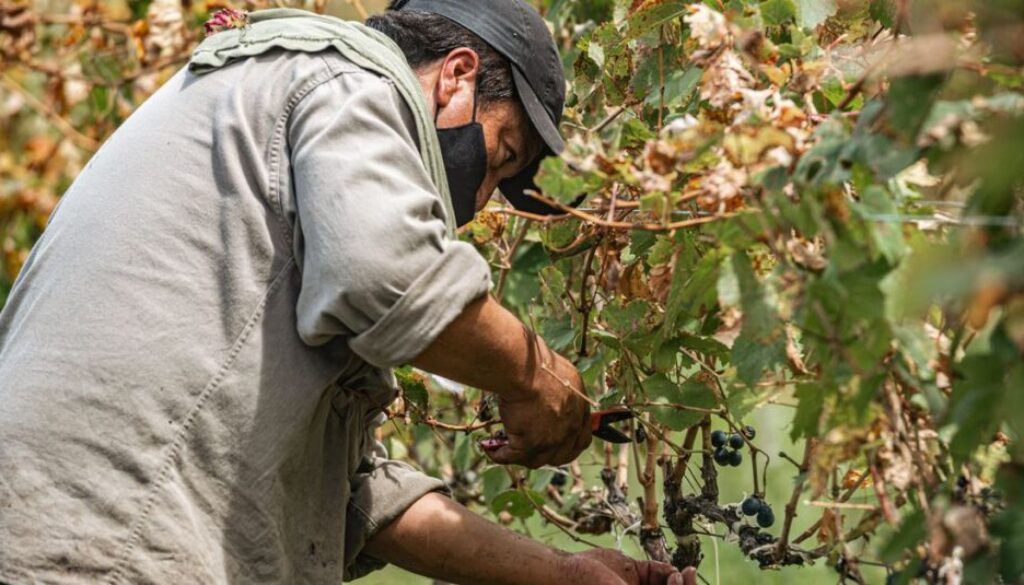
In many parts of Italy, the most important work happened before the first crates reached the winery. Canopy management, cluster shading and constant monitoring of maturity became essential tools for protecting grape balance under thermal stress. In Maremma, where lighter soils and parcels with less access to water suffer more in hot conditions, growers focused on adjusting crop loads and shielding bunches directly from the sun. In some parcels, an earlier harvest of Sangiovese was even considered to help preserve freshness.
The same kind of attention was visible in the Doc delle Venezie, the denomination that spans Veneto, Friuli-Venezia Giulia and the Autonomous Province of Trento. Pinot Grigio behaved differently depending on soils and exposures: where vine balance was maintained, prospects remained solid; where heat hit harder, especially on more permeable ground, growers had to move faster. In Trentino, altitude continues to provide the thermal shifts that help preserve freshness and definition, two qualities central to mountain sparkling wine.
Further west, in the Langhe, the harvest rhythm still follows the traditional timing of the great red wines, but heat also left its mark on white grapes and on the base wines for Alta Langa, which were already being picked in mid-August. Nebbiolo still has a wider window, with picking expected in the second half of September. Even so, the message is unmistakable: even denominations long associated with a later calendar now have to contend with faster timelines.
Another concrete response to higher temperatures came from Franciacorta, where a historic local producer introduced night harvesting. Picking in the coolest hours helps grapes arrive at the winery in better condition, with less oxidation and better preservation of aromatic freshness. It is a practice long established in southern Italy and now moving north as summer temperatures keep rising.
Supply pressure remains in the background
Alongside vineyard decisions, another issue continues to weigh on the sector: the market. Many Italian denominations are managing high stock levels left over from previous vintages, at a time when demand is weak and prices remain under pressure. The most common response has been to cut authorised yields and use administrative storage to hold back part of the crop. Verdicchio dei Castelli di Jesi in the Marche and Montepulciano d’Abruzzo have asked regional authorities to lower production thresholds and temporarily freeze surplus volumes.
The Doc delle Venezie has also moved in this direction, reducing the maximum yield for Pinot Grigio and strengthening the administrative storage mechanism. Not every area is responding in the same way, though. The Maremma Toscana wine consortium has chosen a different approach: rather than focusing on formal limits that no longer explain the picture on their own, it is pushing for structural measures and longer-term planning.
That is where the 2026 harvest becomes most interesting: not as proof of a single rule for all of Italy, but as a set of different responses to the same backdrop. On one side, the need to read ripening more precisely and act faster in the vineyard; on the other, the need not to add more supply to a market that is already struggling to absorb what it has. In between lies a simple word that is becoming harder to put into practice: timing.