Cocktails in three formats: what a changing market looks like
One of the most interesting conversations around cocktails right now is not really about ingredients, but about format. In the United States, the way a drink is served has become a practical response to more selective consumption, different occasions, and a demand for convenience that does not want to give up personality. The experiments are moving in several directions at once, from cans to miniature serves to classics reworked as highballs.
The can has found a new territory
In the U.S. market, spirits-based RTDs have gained ground and, on some sales measures, have surpassed hard seltzers. That shift says a lot about where the category is heading. For years, the can was most closely associated with light, fizzy, informal drinks. Over time, though, that formula started to lose some of its force as the market became crowded and differentiation became harder.
The response has been to move closer to the idea of an actual cocktail: vodka or tequila bases, immediately recognizable flavor cues such as lime, citrus, or mango, and a positioning that aims to combine ease with a stronger sense of quality. In other words, the appeal of ready-to-drink no longer rests only on convenience, but also on the promise of something that feels more like a proper mixed drink.
Partnerships such as Absolut, the Swedish vodka brand owned by Pernod Ricard, with Ocean Spray, the U.S. cranberry beverage producer, or the tie-up between Jack Daniel’s and The Coca-Cola Company, fit into that same logic. They are often framed as a way to use brand familiarity to encourage trial, rather than as simple visibility plays.
Small drinks, chosen deliberately
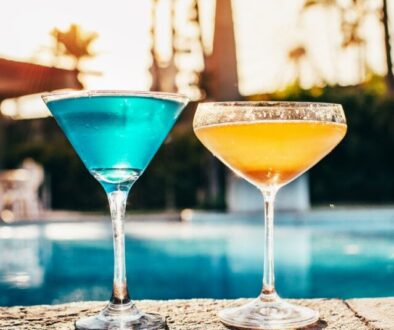
Alongside that convenience-driven logic, there is another movement heading in almost the opposite direction: reduced-size cocktails designed for bars and higher-end restaurant settings. In New York, the newly opened Somssi has introduced a dedicated section for what head bartender Christian Gray calls “little beverages.” These are small drinks served in elegant glasses, not tied to any fixed category, and flexible enough to sit between aperitif, end-of-meal serve, and a simple tasting moment.
The strength of the format lies in that flexibility. A small cocktail can fit into different moments of a meal: at the start, between courses, at the end, or alongside a larger drink. The point is not to create a decorative miniature, but to offer a looser way of drinking, one that encourages exploration without forcing a single commitment.
There is also a practical effect at work. Smaller serves can make drinks accessible when the full-size version might feel demanding because of its structure, alcohol level, or complexity. A beer-based cocktail, for instance, may meet resistance from someone who does not think of themselves as a beer drinker. Scaled down, it loses some of that psychological weight and becomes easier to try.
Lengthening to lighten
The third direction is the classic cocktail reimagined as a highball. Lengthening a Martini with tonic, or reworking a Manhattan or Margarita as a taller, more refreshing drink, can make the result lighter and more suited to longer drinking occasions. It is not about stripping away the drink’s character, but about adjusting the balance to fit a different rhythm.
The context helps explain why this feels timely. In 2025 the U.S. spirits market faced inflationary pressure and a weaker overall backdrop, with mixed performance in traditional volumes. At the same time, consumers did not stop wanting to drink well. They simply started doing it differently, paying more attention to the relationship between quantity, occasion, and pace.
In that sense, the highball works as a kind of middle ground. It preserves the base spirit’s identity, lightens the structure, and delivers a longer drinking experience without demanding a heavy alcohol commitment. It is a format defined less by display than by drinkability.
Can, miniature glass, and reinvented long drink do not add up to a single sweeping transformation, but they do point in the same direction: in the most interesting cases today, cocktails are adapting to more selective consumers and to drinking moments that are more specific than before.