Confluenze in Rome: the wines of Val d’Orcia and Val di Cornia
It is a nice tradition of AIS Lazio to pair the sommelier diploma ceremony with a meeting on a theme or a territory, carefully curated and open to anyone who wants to take part. It is always a pleasure to go, when the calendar allows.
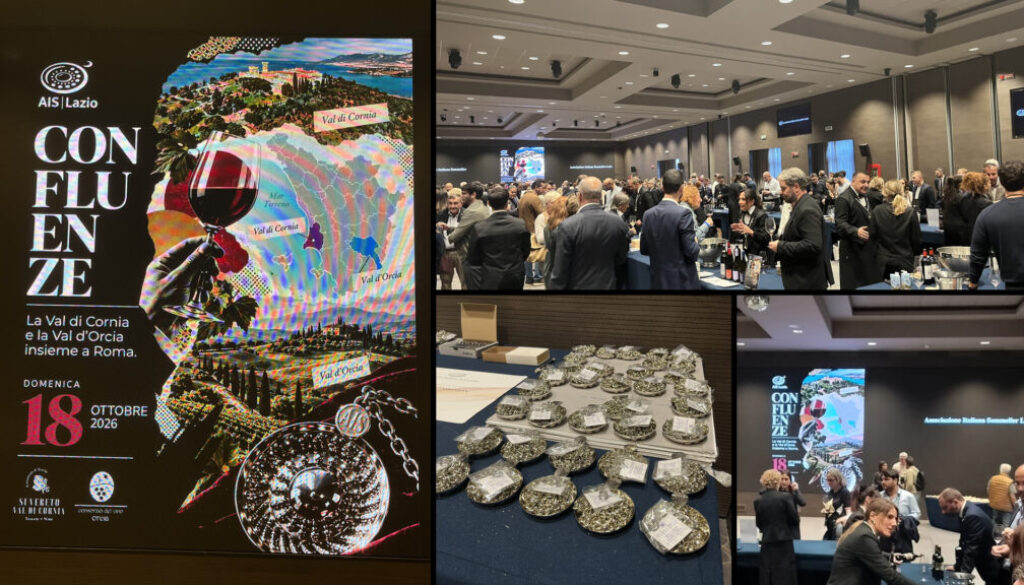
On Sunday 18 October, in Rome, two territories took centre stage: Val d’Orcia and Val di Cornia, brought together in an event called Confluenze. On the stage, the diplomas; in the hall, the tasting tables of the wineries from the two areas.
Where are Val d’Orcia and Val di Cornia?
The event poster, very helpfully, showed the two territories: a map of Tuscany with Val di Cornia in purple and Val d’Orcia in light blue. They are two non-contiguous areas, one on the coast and the other inland.
Val di Cornia lies in the south-west, on the Tyrrhenian Sea. It is the southernmost tip of the province of Livorno on the mainland and extends inland as far as the south of the province of Pisa, bordering Val di Cecina. It takes its name from the river Cornia and reaches the last south-western offshoots of the Colline Metallifere.
Towards the sea the coast is flat, with the exception of the Piombino promontory, which separates the town from the Gulf of Baratti. On a hill of the promontory, above the gulf, stands the medieval village of Populonia. The coastal municipalities are Piombino and San Vincenzo; inland there are Campiglia Marittima, Suvereto, Sassetta and Monteverdi Marittimo, which is in the province of Pisa. The specification of the Val di Cornia DOC includes Suvereto, Sassetta and Monteverdi Marittimo in full, and only part of Piombino, San Vincenzo and Campiglia Marittima.
Val d’Orcia is on the other side, in the south-eastern interior. We are in the province of Siena, along the border with Grosseto and not far from Umbria. The valley stretches north and east of Monte Amiata, and the river Orcia runs through its centre, giving it its name.
The municipalities of the Val d’Orcia Artistic, Natural and Cultural Park are five: Castiglione d’Orcia, Montalcino, Pienza, Radicofani and San Quirico d’Orcia. Sarteano and, in the province of Grosseto, Castel del Piano, with its hamlet of Montenero d’Orcia, also have part of their territory in the valley. On the edges there are Montepulciano, Chianciano and Trequanda. In short, the borders of the valley do not coincide with those of the municipalities. Since 2004 Val d’Orcia has been a UNESCO World Heritage Site.
What are these hills like?
In Italy, everyone knows the hills of Val d’Orcia, at least from photographs. Gentle hills, one behind the other, with white gravel roads running through them and cypresses lined up on either side. Here and there a medieval village, and all around the vineyards, in sunny, ventilated, well-drained positions. The soil is often characterised by clay, sand and marine sediments. It looks like a designed landscape.
Val di Cornia has a different feel. The hills lie between the coast and the interior, and from many vineyards you can see the sea. The breeze coming from the Tyrrhenian tempers the heat, and in front of the coast lies the island of Elba. This is the Etruscan Coast, and at Baratti and Populonia there is an archaeological park: history, in these parts, has long roots.
Why is an event like this useful for people who study wine?
The simplest answer is: because the wine is very good. But the point is another one. Tasting many interpretations of the same grape, made by different wineries within a homogeneous territory, is the fastest way to understand what depends on the place and what on the producer. Soil and climate stay the same, the hands change, and the differences become readable.
For an enthusiast, this is the most important educational part. And at Confluenze you could do exactly that.
We drank several Vermentino, which in the Val di Cornia DOC have a type of their own. Then a great many interpretations of Sangiovese, the main grape of the Orcia DOC (recognised in 2000) and also present in Val di Cornia. And Bordeaux blends, that is Cabernet Sauvignon and Merlot, which arrived in Val di Cornia from the 1980s onwards, following the example of Bolgheri, about twenty kilometres to the north. Rosso della Val di Cornia and Suvereto are today DOCG.
In short, drinking the same grape in many different ways on the same day teaches a lot, more than many pages of a manual. Val d’Orcia and Val di Cornia came to Rome.
And Aleatico?
Among the wines we tried, last but not least, a few Aleatico passiti. Aleatico is a red grape variety, and its most typical area is the island of Elba, which lies right in front of that coast. Elba Aleatico passito has been DOCG since 2011, and the first traces of cultivation on the island date back to Greek and Roman times. The grapes are left to dry, traditionally in the sun, before vinification. Lazio has its own Aleatico too: the one from Gradoli, a DOC in the province of Viterbo, on the north-western shore of Lake Bolsena, which includes a passito type.
In Val di Cornia the DOC includes an Aleatico passito type, made with 100% Aleatico grapes. So: a grape typical of Elba, drunk in Rome, on a day dedicated to two Tuscan territories. What better way to end a tasting?